About Bacton CCS

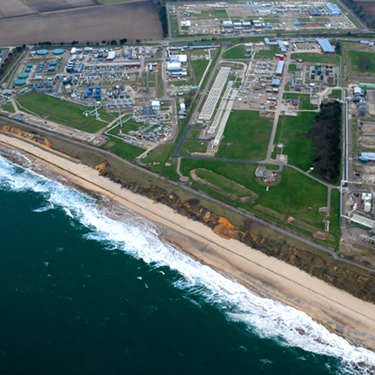
scogliera.jpg

Bacton CCS is a key infrastructure project that aims to substantially decarbonise power and industrial processes across the East Anglia, Thames Estuary and London regions, while also supporting the decarbonisation of industries across North-West Europe. From its strategic location in the UK’s Southern North Sea, Bacton CCS will achieve this by transporting

and permanently storing up to 10 million tonnes of carbon dioxide per year into the Hewett depleted gas field.

In doing so, the project will create jobs and economic growth across the regions it serves, support the energy transition, and deepen cross-border cooperation between the UK and the EU.

Bacton CCS is a key infrastructure project that aims to substantially decarbonise power and industrial processes across the East Anglia, Thames Estuary and London regions, while also supporting the decarbonisation of industries across North-West Europe. From its strategic location in the UK’s Southern North Sea, Bacton CCS will achieve this by transporting and permanently storing up to 10 million tonnes of carbon dioxide per year into the Hewett depleted gas field.

In doing so, the project will create jobs and economic growth across the regions it serves, support the energy transition, and deepen cross-border cooperation between the UK and the EU.

Our objectives

The primary aims are to:

  • Decarbonise and unlock low-carbon growth opportunities.
    Bacton CCS will decarbonise energy-intensive industries and the waste-management sector, while supporting the decarbonisation of UK power generation and the growth of UK data centres
  • Create a strategic gateway for UK and European decarbonisation.
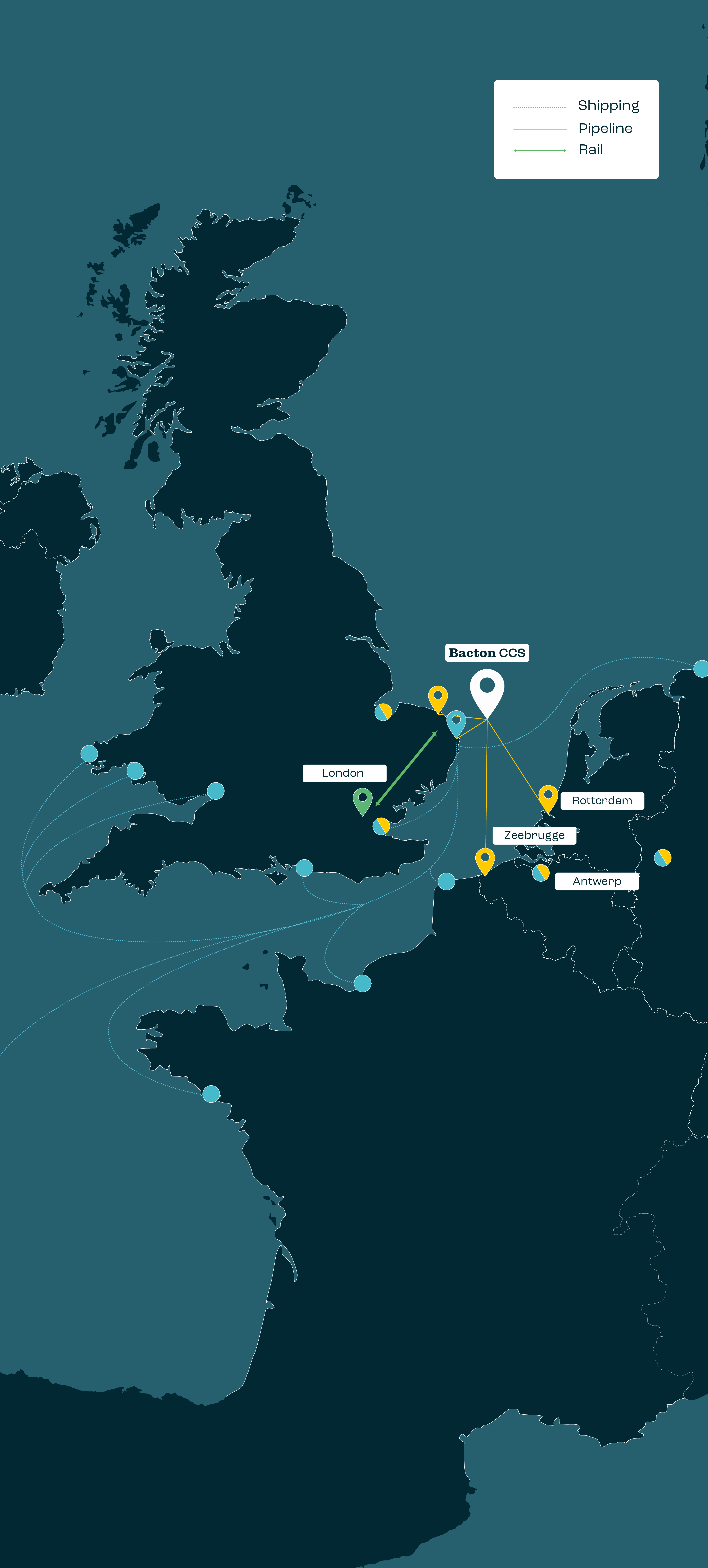
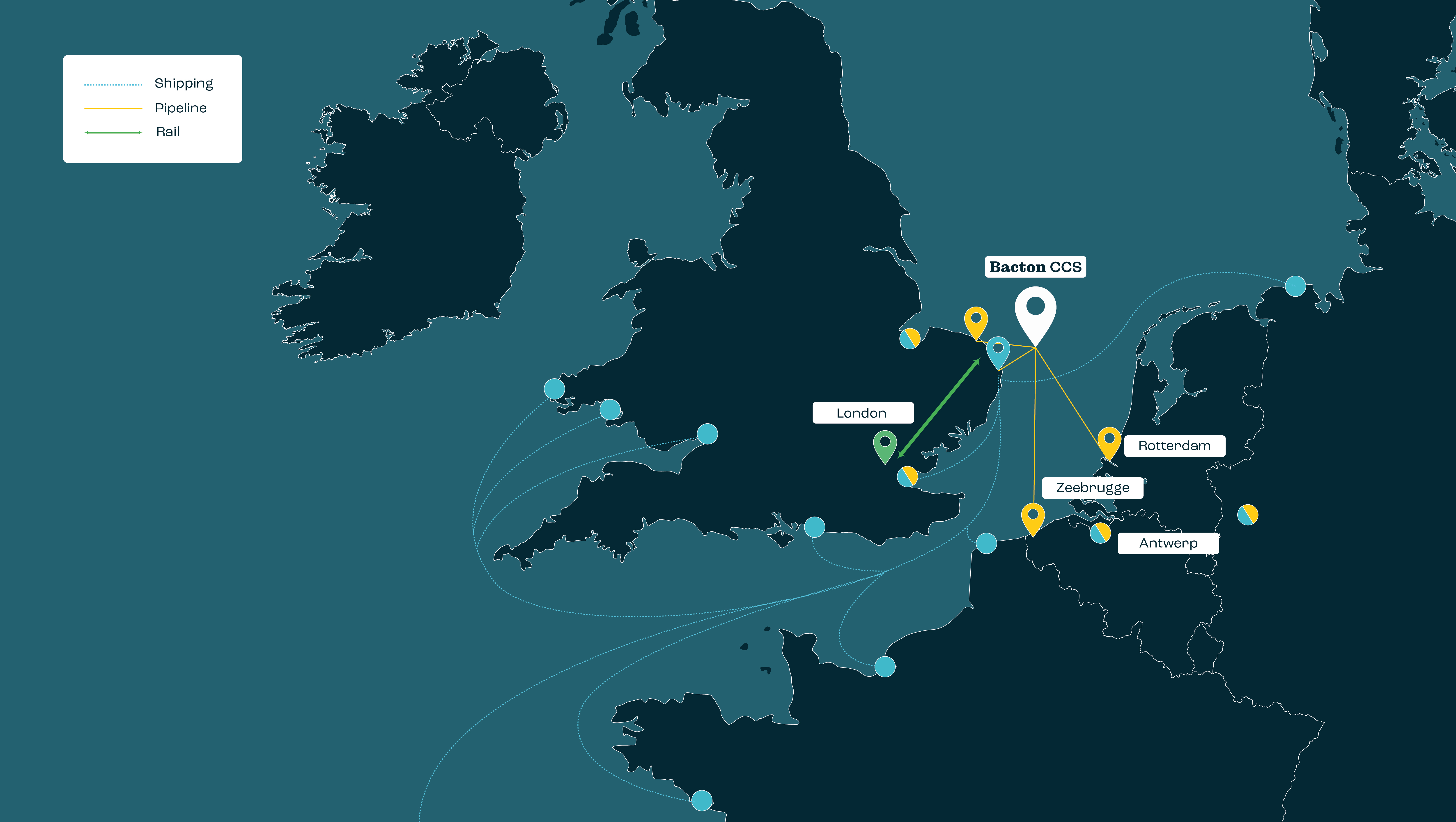
    Thanks to its proximity to North-West Europe, Bacton CCS enables both pipeline and non-pipeline transport solutions for cross-border CO2 flows
  • Supporting the regional economy, industrial competitiveness and skilled employment.
    Bacton CCS will provide the infrastructure needed to transport and permanently store CO2 within the Hewett depleted gas field, which offers an estimated storage capacity of approximately 300 million tonnes of CO2
  • Enabling the development of strategic pipeline, rail and shipping infrastructure.
    Potential new pipeline connections to Belgium and the Netherlands and shipping routes to Spain will connect CO2 sources with storage capacity, serving both UK and EU

Powered by Eni CCUS Holding

piattaforma.jpg

Bacton CCS is being developed through a dedicated Operating Company by Eni CCUS Holding, the UK-based platform that promotes a broad portfolio of international CCS projects and that is jointly controlled by global energy-tech company Eni and BlackRock’s GIP. Eni CCUS Holding’s portfolio

includes Liverpool Bay CCS within the HyNet Cluster, the L10-CCS project in the Netherlands, and Tellus CCS in the UK. The Company also holds the right to acquire the 50% stake held by Eni in the Ravenna CCS project in Italy.

Bacton CCS is being developed through a dedicated Operating Company by Eni CCUS Holding, the UK-based platform that promotes a broad portfolio of international CCS projects and that is jointly controlled by global energy-tech company Eni and BlackRock’s GIP. Eni CCUS Holding’s portfolio includes Liverpool Bay CCS within the HyNet Cluster, the L10-CCS project in the Netherlands, and Tellus CCS in the UK. The Company also holds the right to acquire the 50% stake held by Eni in the Ravenna CCS project in Italy.

What Eni CCUS Holding brings to the project:

  • Extensive experience and subsurface knowledge of the Hewett depleted gas field.
    The company has operated the Hewett offshore field for decades, building a strong understanding of the geology and infrastructure required for long-term CO2 storage
  • A proven track record in carbon transportation and storage development.
    Eni CCUS Holding is already delivering Liverpool Bay CCS, the backbone infrastructure of the HyNet Cluster and one of the UK's leading industrial decarbonisation initiatives, currently under construction
  • Integrated capabilities across the energy value chain.
    It combines expertise in upstream operations, transportation infrastructure, project management, low-carbon energy solutions and industrial decarbonisation
  • Technical capability and financial strength.
    Eni CCUS Holding is backed by a growing international portfolio of projects across the UK, the Netherlands and, in the future, Italy, alongside further opportunities under evaluation in the North Sea, the Mediterranean and Asia-Pacific

Industrial stakeholders

Bacton CCS will work in tandem with a wide range of industrial partners, including:

  • Data centre developers seeking access to secure, scalable and lower-carbon energy solutions, including through off-grid gas-to-power generation integrated with CCS
  • Energy-from-Waste operators in London and the Thames Estuary seeking to decarbonise and future-proof their operations
  • Power generation companies across the Thames Estuary region
  • Low-carbon Hydrogen developers at the Bacton Energy Hub looking to produce and distribute low-carbon energy for industrial processes and unlock abated gas-fired electricity production
  • Industries in Belgium, France, the Netherlands, Germany, Spain and other EU countries that are currently lacking viable alternatives to permanently store their emissions

Facts and figures

  • Location: Hewett depleted gas field is ~20 miles (~30 km) offshore from Bacton (UK), and ~150 miles (~240 km) from Zeebrugge (Belgium)
  • Total carbon storage capacity: ~300 million tonnes in total
  • Annual carbon storage capacity: Potential of up to 10 million tonnes of carbon dioxide annually, in stages, starting from the early 2030s
  • Interconnectivity: Located at the Bacton Gas Terminal alongside existing UK gas infrastructure via the Bacton National Grid transmission system, and connected to continental Europe via Interconnector pipelines
  • European dimension: Bacton CCS is a strategic partner to CarbonConnect, the EU-UK pipeline project led by Interconnector/Fluxys that has received Project of Mutual Interest (PMI) status from the European Union
placeholder-infografica